
Secure Your Data. Eliminate Downtime. Scale with Confidence
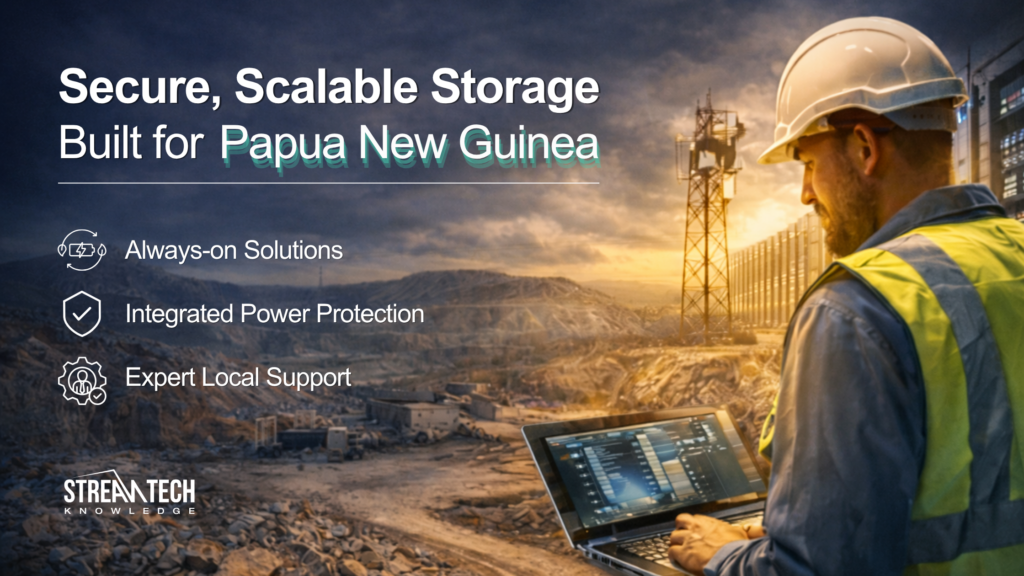
“Our systems are working… but are they really secure?”
Most organisations in Papua New Guinea don’t wake up thinking their storage is a problem.
Systems are running. Data is being stored. Backups exist.
On the surface, everything seems fine.
But if you look a little closer, the real question starts to emerge:
- What happens when power drops during peak operations?
- How quickly can systems recover after a failure – or worse, a cyber incident?
- Can your infrastructure handle the growth your business is planning?
For many IT leaders, there’s a quiet uncertainty:
“We’ve made it work so far… but I’m not sure it will hold under pressure.”
And in PNG’s environment, pressure isn’t hypothetical – it’s inevitable.
Why Data Resilience Matters in Papua New Guinea
Papua New Guinea is undergoing rapid digital transformation.
More organisations are adopting:
- Cloud and hybrid cloud environments
- Data-driven decision-making platforms
- Mobile-first and digital customer experiences
With millions of users in PNG coming online and businesses investing in digital capabilities, the demand for reliable data storage solutions in Papua New Guinea is growing fast.
But PNG presents a unique operational landscape.
1. Power Instability Creates Hidden Risk
Power disruptions are not uncommon. Even short outages can:
- Corrupt active data
- Interrupt backups
- Damage hardware
- Trigger system downtime
Traditional storage systems are not designed to handle this level of unpredictability. HPE addresses this by delivering zero data loss and downtime through synchronous replication and transparent failover across active sites. The HPE platform guarantees data availability, ensuring workloads remain online even during disasters.
2. Cyber Threats Are Increasing
As organisations become more connected, they also become more exposed.
Ransomware, data breaches, and system intrusions are no longer distant threats—they are real risks.
- Without resilient storage systems:
- Backups may be compromised
- Recovery may be delayed
- Critical data may be permanently lost
HPE integrates immutable snapshots and plans to leverage Zerto Continuous Data Protection (CDP) to provide real‑time, adaptive anomaly detection that protects against ransomware. AI‑managed services predict and resolve 86 % of problems before they cause disruptions, giving IT teams confidence that threats will be detected and mitigated proactively.
3. Data Growth Is Outpacing Infrastructure
Modern businesses generate more data than ever before:
- Customer transactions
- Video and media files
- Application logs
- IoT and operational data
Legacy storage systems struggle to scale efficiently, leading to performance bottlenecks, increased costs and operational complexity. HPE Alletra Storage MP X10000 can scale up to exabytes of data and is an all‑flash server that is claimed to be as much as six times faster than competing object storage servers. It is fully S3‑compatible and uses advanced deduplication to achieve data reduction of up to 20×. Its Multi‑Protocol architecture allows organisations to consolidate block, file and object storage in one platform and independently scale compute and storage.
4. Limited IT Resources
Many organisations in PNG operate with small IT teams. Managing complex storage environments becomes a burden, increasing the risk of misconfigurations, delayed responses to incidents and inefficient use of resources. HPE’s AI‑driven cloud management delivers up to 99% operational time savings and 100× faster provisioning while reducing storage administration hours by 43%. This allows lean IT teams to focus on innovation rather than routine maintenance.
What Is Data Resilience (And Why It Matters)?
Data resilience refers to an organisation’s ability to maintain data availability during disruptions, recover quickly from failures or cyber incidents and protect data integrity across environments. In practical terms, it means:
- Your systems keep running – even when conditions aren’t ideal
- Your data is recoverable – without long delays
- Your infrastructure adapts – as your business grows
For organisations in Papua New Guinea, data resilience isn’t optional – it’s foundational. HPE solutions guarantee 100 % data availability, ensuring that essential services remain online and that data can be recovered quickly and without loss.
Where Traditional Storage Falls Short
Many organisations still rely on legacy or fragmented storage systems that were not designed for today’s demands. Common challenges include:
- Performance limitations: systems slow down under heavy workloads, affecting business operations.
- Unreliable backup processes: backups may take too long or fail silently, leaving organisations exposed.
- Complex recovery procedures: in a crisis, recovery steps are unclear, untested or too slow.
- Disruptive scaling: expanding capacity often requires downtime and significant investment.
By contrast, independent tests show that HPE’s intelligent storage platform can reduce storage costs by 40%, shrink the data centre footprint by 30% and lower power consumption by 45%. ESG economic validation also found that advanced data reduction and intelligent management provided a 31% reduction in overall storage costs and improved sustainability metrics.
Modern Enterprise Storage: A Different Approach
Today’s storage solutions are designed to solve these challenges.
Modern enterprise storage is:
- Predictive – identifying and resolving issues before they occur
- Resilient – maintaining uptime even in unstable conditions
- Scalable – growing without disruption
- Secure – protecting data from evolving threats
This is where HPE storage solutions are changing the conversation. With a platform built on composable, disaggregated architecture and AI‑driven operations, HPE offers zero data loss or downtime via synchronous replication and transparent failover. The result is continuous data availability and predictable recovery when disruptions occur.
How HPE Storage Solutions Address PNG’s Challenges
Hewlett Packard Enterprise (HPE) takes a different approach to storage – one built for real‑world environments. The portfolio includes HPE Alletra, HPE GreenLake and HPE object storage solutions, all delivered locally by Stream Tech Knowledge PNG Ltd.
HPE Alletra: Intelligent, Always-On Infrastructure
HPE Alletra is designed for organisations that cannot afford downtime. More than just a high‑performance array, the platform consists of a single model – the Alletra Storage MP B10000 – built on a composable, disaggregated, scale‑out architecture. This means capacity and performance scale independently, extending hardware life and avoiding forklift upgrades.
Key differentiators include:
- 100% data availability guarantee: Unlike competitors that offer 99.9999 % uptime, HPE guarantees continuous availability when deployed with a minimum three‑year support agreement. This ensures mission‑critical workloads stay online, even during component failures or power events.
- AI‑driven operations: HPE GreenLake AIOps manages the B10000 and integrates with HPE InfoSight for cross‑stack visibility and predictive analytics. This helps detect anomalies, optimise performance and reduce manual intervention.
- Immutable snapshots and cyber resilience: The platform provides built‑in immutable snapshot capabilities and will leverage Zerto CDP for continuous, real‑time replication and anomaly detection to protect against ransomware and data corruption.
- Multi‑protocol consolidation: The Alletra Storage MP X10000 can deliver block, file and object storage on the same system. It scales to exabytes of data, offers S3 compatibility and uses deduplication technology to achieve up to 20× data reduction. HPE says it is six times faster than competing object storage servers. The Multi‑Protocol architecture lets organisations choose a file, block or object configuration at purchase and later extend to other workloads while independently scaling compute and storage.
With these capabilities, Alletra ensures that systems remain operational during power fluctuations, performance stays consistent under heavy load and IT teams spend less time firefighting.
HPE GreenLake: Flexible, Consumption-Based IT
Many organisations struggle to balance growth with cost. HPE GreenLake addresses this by offering infrastructure as a service with pay‑as‑you‑use pricing. GreenLake delivers on‑premises control with cloud flexibility, allowing organisations to scale resources without overprovisioning.
Beyond flexible financing, GreenLake includes AI‑driven operations through HPE GreenLake AIOps. This integrates with HPE InfoSight to provide cross‑stack visibility, performance insight and predictive analytics. Combined with Alletra, GreenLake offers a unified management plane and delivers the same 100 % availability guarantee when deployed under the appropriate support SLA.
For organisations in PNG, this model reduces upfront capital expenditure, aligns infrastructure costs with actual usage and enables faster adoption of modern technologies while maintaining data sovereignty and control.
HPE Object Storage: Built for Unstructured Data Growth
Data is no longer limited to structured databases; organisations must store video surveillance, sensor readings, logs and digital records. HPE’s object storage solutions – such as the Alletra Storage MP X10000 object service – are optimised for these workloads. Key attributes include:
- Exabyte scalability: The system scales to exabytes of capacity and can read or write object data rapidly.
- Performance: According to HPE, the object storage platform is up to six times faster than competing object storage servers. It is all‑flash, minimising latency and maximising throughput for unstructured data.
- Efficient data reduction: Deduplication technology enables data reduction rates of up to 20×, improving storage efficiency and lowering costs.
- Multi‑protocol support: Object storage sits alongside block and file services on the Alletra MP platform, allowing unified management and independent scaling.
- AI integration: Support for direct memory access (DMA) with Nvidia GPUs allows AI workloads to access object data with lower latency and higher bandwidth
These features make HPE object storage an ideal foundation for IoT, AI and analytics workloads that generate massive volumes of unstructured data.
Use Cases: How Different Industries in PNG Benefit
Banking & Financial Services
- Secure transaction data with encryption and immutable snapshots
- Rapid disaster recovery via synchronous replication and real‑time failover
- Compliance with data protection requirements and improved audit readiness
Telecommunications
- Manage massive data volumes with exabyte‑scale object storage
- Ensure uptime for critical services with 100 % availability guarantee
- Support network expansion with flexible, pay‑as‑you‑use capacity
Government & Public Sector
- Protect citizen data with encryption, access controls and ransomware protection
- Ensure continuity of essential services with active‑active replication
- Enable digital transformation initiatives using a hybrid cloud platform
Energy & Mining
- Store operational and sensor data at remote sites with edge‑ready object storage
- Maintain system uptime in remote locations through disaggregated, scale‑out architectures
- Support real‑time analytics to improve safety and productivity
Why Implementation Matters More Than Technology
Even the best technology can fail if it’s not designed and implemented for the environment it operates in. In Papua New Guinea, infrastructure decisions must account for power instability, remote and distributed locations, connectivity limitations and environmental conditions. HPE’s architecture is engineered for these realities, but success ultimately depends on how systems are delivered and supported.
The Role of Stream Tech Knowledge PNG Ltd
Stream Tech Knowledge PNG Ltd bridges the gap between technology and real‑world application. Rather than simply supplying products, we deliver integrated solutions. Our approach combines HPE enterprise storage solutions, power infrastructure and protection systems, networking and cybersecurity, and training and ongoing local support.
Organisations in PNG prioritise reliability, simplicity and local expertise. Stream Tech’s model directly addresses these priorities, ensuring that systems are not only deployed but supported and optimised over time.
Comparing Traditional vs Modern Storage
Feature | Traditional Storage | HPE Modern Storage |
Availability | Limited, vulnerable to outages | Always‑on architecture with data availability guarantee. |
Scalability | Disruptive upgrades, fixed appliances | Seamless scale‑out; exabyte capacity; independent scaling of compute and storage with 20× data reduction. |
Management | Complex, manual administration | Simplified, AI‑driven operations delivering 99% time savings and 43% reduction in admin hours. |
Security | Reactive and siloed | Built‑in, proactive protection with immutable snapshots, ransomware detection and 86% of problems predicted/resolved. |
Cost Model | CapEx‑heavy; high power and footprint | Flexible (GreenLake); 40% lower storage costs, 30% smaller footprint, 45% lower power consumption; 31% cost reduction validated in studies. |
What This Means for Your Organisation
Organisations that rethink their storage strategy often see measurable outcomes:
- Reduced downtime: Active‑active replication and 100 % data availability virtually eliminate unplanned outages.
- Faster recovery: Continuous replication and CDP enable near‑instant recovery with zero data loss.
- Improved performance: All‑flash architecture and AI‑driven optimisation maintain consistent throughput and reduce latency – up to six times faster than competing object storage.
- Lower total cost of ownership: Advanced data reduction reduces storage costs by 40%, cuts footprint by 30% and lowers power consumption by 45%, while a consumption model aligns costs with usage.
- Operational efficiency: AI‑driven automation delivers 99% operational time savings, 100× faster provisioning and a 43% reduction in admin hours, freeing IT teams to focus on value‑added tasks.
- Enhanced security: Immutable snapshots and AI‑driven anomaly detection protect against ransomware and data corruption, resolving 86 % of issues before they impact operations.
Beyond the technical benefits, there is greater confidence in your infrastructure, which translates into better decision‑making, faster innovation and stronger competitiveness.
Frequently Asked Questions (FAQ)
What are HPE storage solutions?
HPE storage solutions are enterprise‑grade systems designed to provide scalable, secure and resilient data storage across on‑premises and hybrid cloud environments. They include block, file and object services consolidated in the HPE Alletra MP platform, all managed through HPE GreenLake.
Why is data resilience important in Papua New Guinea?
Due to power instability, increasing cyber threats and rapid data growth, organisations in PNG need systems that maintain availability and recover quickly from disruptions. HPE’s 100% availability guarantee and AI‑driven operations ensure that systems remain online and data is protected.
What is HPE GreenLake?
HPE GreenLake is a consumption‑based IT model that allows organisations to pay for infrastructure as they use it, combining on‑premises control with cloud flexibility. It integrates HPE InfoSight and AIOps for cross‑stack analytics and performance optimisation.
How does HPE Alletra improve reliability?
HPE Alletra uses a disaggregated, scale‑out architecture with built‑in redundancy, synchronous replication and AI‑driven analytics to predict and prevent issues. It delivers a 100% data availability guarantee, providing continuous access to mission‑critical workloads.
Why is object storage necessary for modern businesses?
As data becomes more unstructured, object storage provides a scalable and cost‑effective way to manage large datasets. HPE’s object storage platform scales to exabytes, delivers up to six times faster performance than competitors and achieves up to 20x data reduction.
A Different Way to Look at Your Infrastructure
If your current storage environment is working, change may not feel urgent. But it’s worth asking:
- How resilient is your system under real‑world conditions?
- How quickly could you recover from a major disruption?
- Is your infrastructure ready for the next phase of growth?
Exploring these questions isn’t about fear – it’s about clarity. A structured assessment can provide insight without forcing immediate change.
A Practical Next Step
Many organisations begin with a structured assessment of their environment.
This includes:
- Storage performance and utilisation
- Backup and recovery readiness
- Power-related risks
- Opportunities for optimisation
This approach provides insight without forcing immediate change.
Final Thought: Building for What Comes Next
Digital transformation in Papua New Guinea is accelerating. Success isn’t just about adopting new technology; it’s about ensuring that technology works reliably in the environment it operates in. HPE storage solutions provide the performance, resilience and scalability required to meet these demands. With Stream Tech Knowledge PNG Ltd as your partner, you can build a storage foundation that not only supports current operations but also prepares your organisation for future growth.