
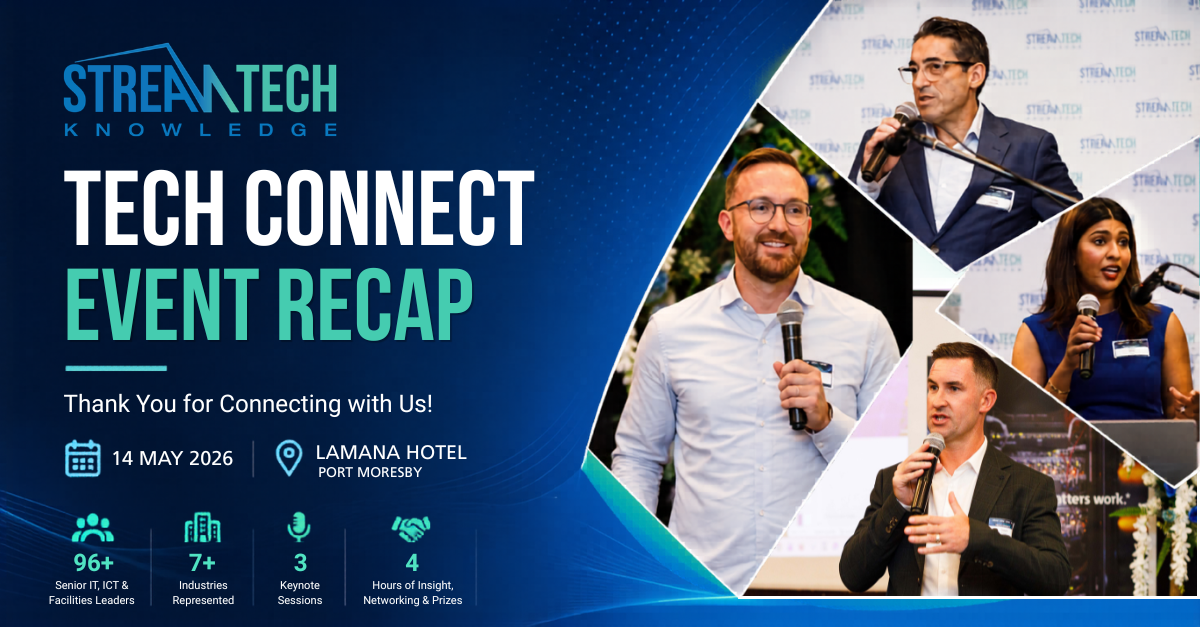
On Thursday 14 May 2026, Stream Tech Knowledge PNG brought together more than 150 IT leaders, CIOs, CTOs, infrastructure managers and facility heads from across Papua New Guinea’s most critical organisations for Papua New Guinea Tech Connect 2026 — an exclusive executive briefing held at the Lamana Hotel in Port Moresby. Co-hosted with global partners Hewlett Packard Enterprise (HPE), Eaton and Dicker Data, the evening tackled the three challenges that define enterprise IT in PNG today: power resilience, secure digital transformation, and future-ready hybrid infrastructure.
Senior representatives from HPE and Eaton flew into Port Moresby to share the latest global thinking on enterprise storage, AI-ready data centres, ransomware defence, and intelligent power management — then translated those insights into practical strategies tailored to PNG’s unique operating environment. This recap captures what was shared, why it matters, and what local IT and facilities leaders can do next.
Event at a glance
By the numbers
- 96+ senior IT, ICT and facilities leaders in the room
- Representation from banking, government, mining, telecommunications, healthcare, education and utilities
- Three keynote sessions from Stream Tech, HPE and Eaton — plus a live partner panel
- 4 hours of insight, dinner, networking, live entertainment and prizes — including an Apple Watch
- Held at Lamana Hotel, Port Moresby, 5 PM – 9 PM, Thursday 14 May 2026
Why PNG, why now: the context behind Tech Connect 2026
Papua New Guinea is in the middle of one of the fastest digital transitions in the Pacific. The economy is forecast to grow around 5% in 2026, more than 2.8 million Papua New Guineans are online, and 1.1 million are active on social media. The PNG government’s Digital Transformation Policy is pushing public administration toward shared platforms, digital authentication and whole-of-government services, while financial institutions, mining operators and utilities are aggressively modernising to keep pace with global standards.
But ambition is bumping against three hard realities. First, power instability — frequent outages, voltage sags and surges silently shorten the life of every server, switch and storage array in the country. Second, the cyber threat landscape has caught up with PNG: the 2021 ransomware attack on the Department of Finance was a wake-up call, and adversaries have grown more sophisticated since. Third, the skills gap is real — cloud security, incident response and infrastructure engineering roles are in high demand and short supply.
Tech Connect 2026 was designed to address those realities head-on. The brief was simple: stop talking about technology in the abstract, and start building IT environments that can survive PNG’s power grid, defend against modern ransomware, and scale into the AI-enabled decade ahead.
Opening keynote: Local expertise meets global technology

Andy Obeidi, CEO, Stream Tech Knowledge PNG
Stream Tech Knowledge CEO Andy Obeidi opened the evening with a clear thesis: PNG businesses don’t need another offshore vendor selling them a global playbook; they need a local partner who can translate that playbook into PNG conditions. Stream Tech’s position is built on three pillars: access to global technology through partnerships with HPE, Eaton, Cisco, Microsoft, Fortinet and Forcepoint; local expertise from a Port Moresby-based engineering, sales and training team; and end-to-end delivery across procurement, professional services, managed services and accredited certification training.
The keynote framed the rest of the evening around a single question every IT leader in the room is asked by their executive team: “if we lose power, lose data or lose access tomorrow, what’s our recovery plan?” Stream Tech’s answer is that the recovery plan needs to be designed into the infrastructure from day one and not bolted on after an incident. The keynote set up two sessions that would unpack exactly how to do that, starting with storage and ending with power.
HPE session: Reimagining hybrid storage for the AI and ransomware era
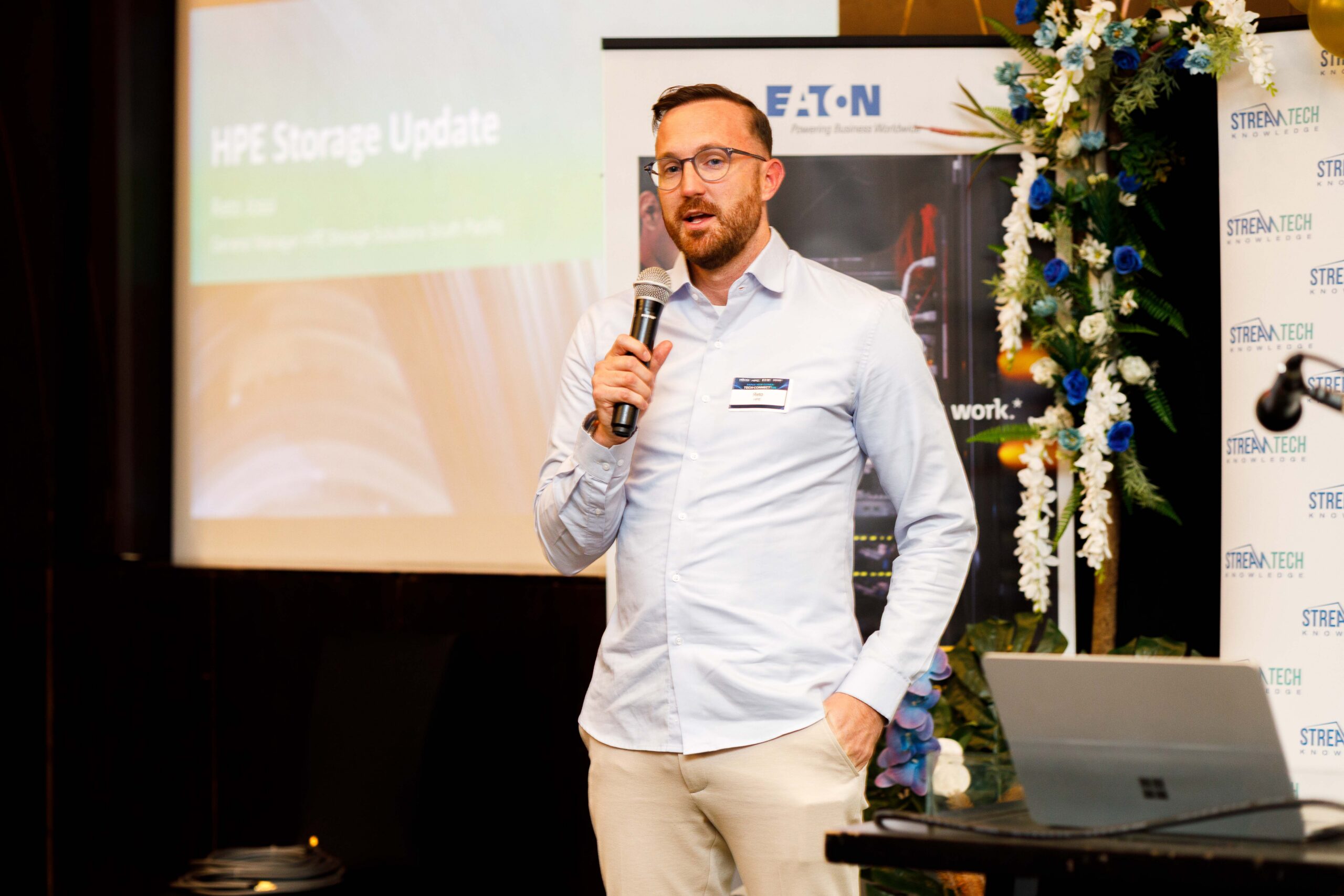
Reto Jossi, General Manager HPE Storage Solutions, South Pacific
Reto Jossi flew in from HPE’s South Pacific team to deliver a frank assessment of how enterprise storage has changed — and how most platforms haven’t kept up. His talk landed on what HPE calls the three IT mega-trends shaping every CIO’s 2026 agenda: the AI gold rush, the great VM reset (driven by post-Broadcom VMware licensing changes), and the security imperative as ransomware now targets data itself rather than just the perimeter.
“The enterprise storage problem has changed. Most platforms haven’t. Virtualisation is a new imperative, security threats now target data itself, and the old trade-offs between TCO and flexibility are no longer acceptable.”
— Reto Jossi, HPE
HPE Alletra Storage MP B10000: the headline platform
The centrepiece of the HPE session was the Alletra Storage MP B10000 — what HPE describes as the industry’s first disaggregated block and file storage system. The architecture matters for PNG because it lets organisations independently scale performance and capacity in one-node increments, rather than over-provisioning expensive hardware up front. For organisations operating with foreign exchange constraints and long lead times on imported equipment, the ability to grow infrastructure in small steps is a real budget advantage.
HPE shared the headline numbers: zero over-provisioning, up to 40% cost savings versus non-disaggregated architectures, and 45% energy reduction when transitioning from spinning disk to the all-flash Alletra platform. The system supports up to 6 controller nodes, scales from 15TB to 5.9PB, and is backed by a 100% Data Availability Guarantee. Importantly for PNG, it’s engineered for energy efficiency by design, which is relevant for any data centre running on constrained power.
Native ransomware detection — built into the storage layer
The most attention-grabbing part of the HPE talk was the demonstration of native ransomware detection. Rather than relying on a separate security product, the Alletra MP B10000 uses real-time AI-driven anomaly detection at the block and file level, monitoring data entropy to catch the latest ransomware techniques, including the slow-encryption and tiny-amount-encryption methods that defeat most legacy detection. HPE’s Cybersecurity Centre of Excellence has evaluated the platform against more than 100 ransomware strains, and it is backed by a Cyber Resiliency Guarantee.
The framework was aligned to the NIST Cybersecurity Framework (Govern, Identify, Protect, Detect, Respond, Recover), that is a deliberate choice given that PNG’s emerging National Cyber Security Strategy and the National Computer Emergency Response Team are converging on internationally recognised standards. For IT managers preparing for the data protection legislation expected over the coming years, building on NIST alignment now means less rework later.
The VMware reset and HPE Morpheus VM Essentials
Reto closed with a frank discussion of what many in the room are quietly dealing with: VMware licensing changes have driven 3x to 5x cost increases for some customers, forcing strategic re-evaluation of virtualisation. HPE Morpheus VM Essentials offers a KVM-based hypervisor licensed per socket (not per core), with external storage support, distributed workload placement, integrated data protection, and built-in migration from ESXi. HPE shared a 3-year TCO analysis showing up to 88% savings on a typical four-host, 256-core deployment. For PNG organisations facing both budget pressure and the need to keep critical workloads running, it’s an option worth modelling against current VMware renewals.
Eaton session: Powering critical infrastructure in Papua New Guinea
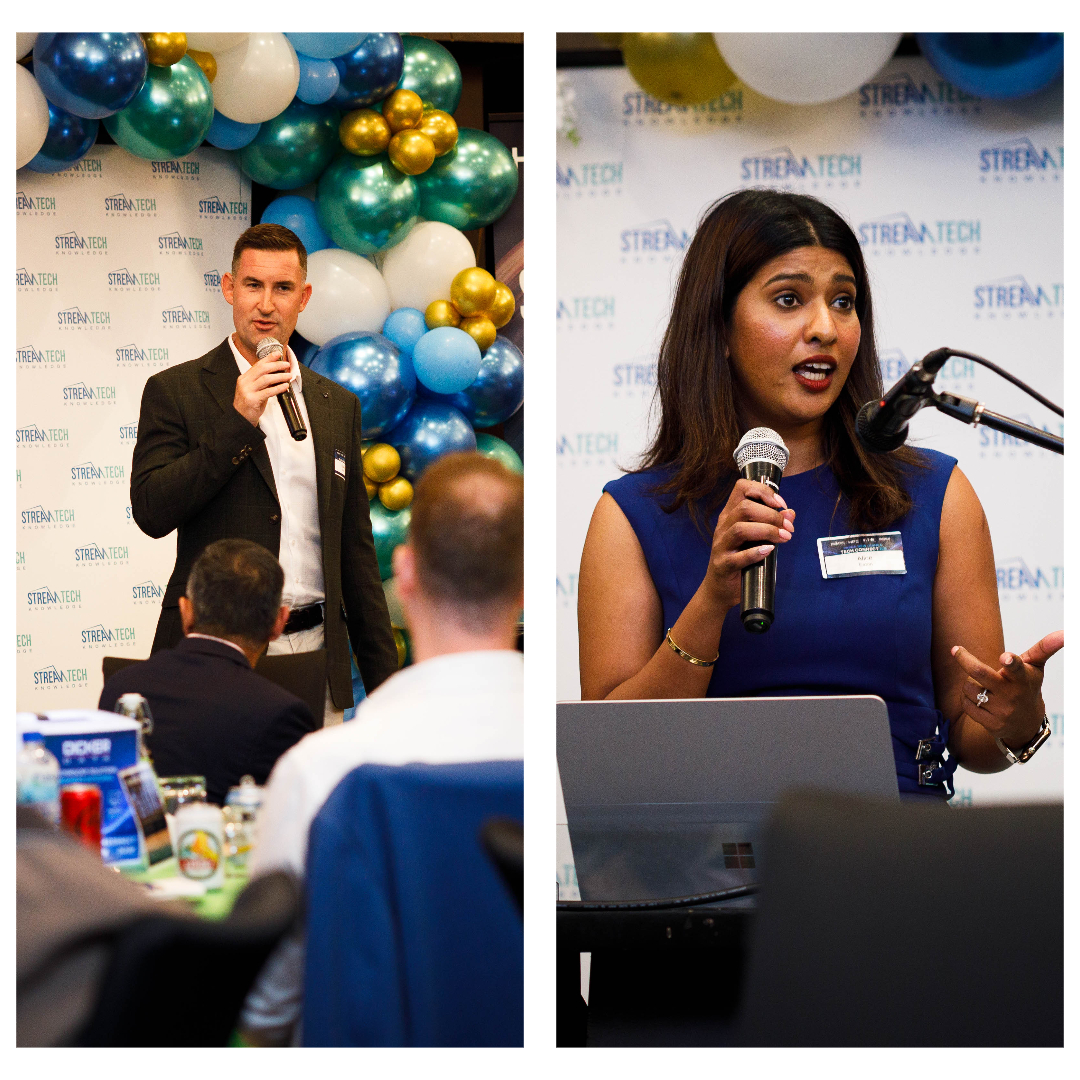
Gavin Swadling, General Manager Power Quality and Data Centres ANZ Alice Desai, National Channel Manager Power Quality
If the HPE session was about what runs on top of the infrastructure, the Eaton session was about what keeps it alive. Gavin Swadling opened with a statement of intent: “there is no better time than now to be an intelligent power management company.” For PNG, where power quality is a daily operational issue rather than an occasional concern, that framing landed with the audience immediately.
The PNG power reality
Alice Desai then mapped out the conditions every IT manager in the room is working under: unreliable and inconsistent grid power, frequent outages and voltage fluctuations, remote sites with limited infrastructure support, and increasing dependence on digital systems and connectivity; all while equipment sits exposed to poor power quality. Eaton’s data shows organisations now experience eight times more power-related issues than they did a decade ago. In PNG, that multiplier is felt acutely.
The Harmful 9 — what’s actually killing your equipment
One of the most useful slides of the evening was Eaton’s breakdown of what they call the Harmful 9: the nine power-quality issues that damage IT equipment and shorten its lifespan. They are: power failure, power sag, power surge, under-voltage, over-voltage, line noise, frequency variation, switching transients, and harmonic distortion. Most facility teams plan for the first three. The other six quietly degrade hardware, corrupt data, and trigger the kind of “intermittent” faults that drive up support costs.
The Harmful 9 — designed power protection for each
1. Power failure
2. Power sag
3. Power surge
4. Under-voltage
5. Over-voltage
6. Line noise
7. Frequency variation
8. Switching transient
9. Harmonic distortion
Eaton’s 9 Series Double Conversion UPS is engineered to protect against all nine.
Eaton’s end-to-end PNG capability: Organise, Protect, Manage
Eaton structured its PNG capability around three pillars. Organise covers the physical layer: racks and enclosures from 6U through 42U, outdoor enclosures for remote sites, and the new G4 Power Distribution Units (PDUs) that keep servers, switches and storage safe and secure. Protect is the power layer: the 3 Series Standby and 5 Series Line Interactive UPS systems for desktop and network closet applications, the 9 Series Double Conversion UPS for mission-critical workloads, and the 3 Phase Solutions range for full data-centre deployments, that is all backed by surge protection, maintenance bypass modules and extended warranty services.
Manage is where the picture gets interesting. Eaton’s Brightlayer software platform and Intelligent Power Manager give organisations remote visibility, automated control and predictive insight across every UPS, PDU and rack in the estate. For PNG organisations with distributed operations — mining sites, regional bank branches, telco towers, port facilities, and being able to manage power infrastructure from a central console is a step change in operational discipline.
Power infrastructure is now a cybersecurity asset
The other point that landed strongly was Eaton’s position on cyber-hardened power. Eaton’s UPS network management cards are the first to achieve dual UL and IEC security certification, and Eaton operates the first research and testing facility in UL’s Cybersecurity Client Lab Validation Program. Their Secure Development LifeCycle (SDLC) process builds cybersecurity into the firmware from the start, certified by UL and IEC. In an era when attackers have begun targeting building management systems and connected infrastructure, the firmware running on the device that keeps your data centre alive is now part of your attack surface, and treating it as such is no longer optional.
Who was in the room
The strength of Tech Connect 2026 was the seniority and sector breadth of the audience. CIOs, CTOs, Heads of IT, Heads of Information Security, Infrastructure Managers, Network Engineers, Facilities Managers and Property Managers.
The mix mattered. The conversations during dinner and networking moved naturally between people who run banking core systems, people who keep ports moving, and people responsible for university research networks — and the common ground turned out to be the same three problems: keep the lights on, keep the data safe, and modernise without breaking the budget.
Networking, dinner, live entertainment and prizes
Tech Connect was deliberately designed as more than a content-only event. After the keynotes, guests moved into a full-service dinner at the Lamana Hotel ballroom, where the conversations that started during the Q&A continued over food and drinks. Live entertainment ran across the evening, and a prize draw, headlined by a brand-new Apple Watch and other prizes, and closed out the night to a packed and energised room.
Several attendees commented that the format worked because it created the right ratio of structured content to unstructured time. IT leaders in PNG rarely get this many of their peers in the same room; the value of comparing notes on what’s working in adjacent industries is hard to overstate.
Five key takeaways for PNG IT leaders
Five key takeaways for PNG IT leaders
If the power layer is unreliable, no amount of cloud strategy, AI tooling or cybersecurity investment delivers its promised value. Start with a power infrastructure audit, including UPS rating, runtime, maintenance status, monitoring coverage, and build out from there. Eaton’s 9 Series Double Conversion UPS plus Brightlayer monitoring is the reference architecture for mission-critical workloads in PNG.
2. Ransomware defence belongs at the data layer
Perimeter and endpoint security still matter, but modern ransomware defeats both. Storage platforms with native, real-time anomaly detection, like HPE Alletra MP with its NIST-aligned protection workflow are now part of the baseline. Combine that with immutable snapshots and automated recovery to shorten the worst day of your year from weeks to hours.
3. Plan now for the VMware reset
Three-to-five-times cost increases on VMware licensing are not hypothetical. Model a 3-year TCO under both your current VMware path and a KVM-based alternative such as HPE Morpheus VM Essentials. Even if you don’t migrate, the model gives you negotiating leverage and an exit option.
4. AI workloads will change your storage and power profile
Even modest AI adoption including copilots, retrieval-augmented chatbots, document intelligence that shifts the I/O profile of your storage and the thermal profile of your data centre. Disaggregated, all-flash architectures and rack-level power monitoring give you the headroom to absorb AI workloads without re-platforming.
5. Build local skills alongside the infrastructure
The skills gap is real, and managed services are only part of the answer. Stream Tech’s accredited Cisco and Microsoft training program, including certification pathways from Fundamentals through Expert and Architect give organisations a way to build internal capability while infrastructure projects are being delivered. Skills built during the project tend to stay with the project.
What’s next — and how to keep the conversation going
Stream Tech Knowledge will be running follow-up sessions and one-on-one executive briefings throughout the second half of 2026. If you attended Tech Connect 2026, look out for the post-event survey in your inbox your feedback directly shapes the agenda for the next event. If you missed it, the Stream Tech team is available to host private briefings with HPE and Eaton specialists, run a power infrastructure audit at your site, or scope a proof-of-concept on HPE Alletra Storage MP or Eaton 9PX UPS in your environment.
Areas where Stream Tech can engage directly:
- Power infrastructure audit and UPS sizing assessment (Eaton 3 Series, 5 Series, 9 Series and 3 Phase Solutions)
- Storage modernisation workshops with HPE Alletra Storage MP B10000 and Zerto cyber resilience
- VMware-to-KVM TCO modelling and HPE Morpheus VM Essentials proof-of-concept
- Ransomware readiness assessment and NIST-aligned cyber resilience design
- Cisco and Microsoft accredited certification training pathways
- Managed services scoping for 24/7 monitoring, backup and incident response
Frequently asked questions from Tech Connect 2026
Below are some of the most-asked questions from the floor on the night, captured for those who couldn’t attend — and as a quick reference for anyone now scoping a project internally.
What is the HPE Alletra Storage MP B10000 and how is it different from traditional enterprise storage?
HPE Alletra Storage MP B10000 is the industry’s first disaggregated block and file storage platform. Unlike traditional all-in-one storage arrays, the disaggregated architecture separates compute (controller nodes) from capacity (JBOFs — Just a Bunch of Flash), connected over a high-speed Ethernet fabric. The practical benefit is that you can independently scale performance and capacity, in one-node increments, up to six controller nodes. For PNG organisations dealing with import lead times and FX exposure, that means less over-provisioning, lower upfront capital outlay, and the ability to grow the platform in step with actual workload demand.
How does native ransomware detection at the storage layer actually work?
Most ransomware detection runs at the endpoint or network layer, watching for known signatures or behaviour patterns. HPE’s native detection runs at the block and file level inside the storage controller, using AI-driven analysis of data entropy; essentially, the statistical “randomness” of the data being written. Encrypted data has a different entropy signature than normal data. When the system detects an anomaly that matches a ransomware pattern, it automatically protects immutable snapshots and alerts the security team. Because it sits at the data layer, it catches even the newer slow-encryption and partial-encryption methods that bypass endpoint tools.
What is the difference between Eaton 3 Series, 5 Series and 9 Series UPS?
They’re positioned for different criticality tiers. The 3 Series Standby UPS is for desktop and SOHO applications where short power interruptions are the main risk. The 5 Series Line Interactive UPS adds voltage regulation for network closets and small server rooms where line noise and voltage fluctuations matter. The 9 Series Double Conversion UPS continuously rebuilds clean sine-wave output regardless of input quality that this is the right choice for mission-critical data rooms, core banking systems, hospital servers and any workload where a single transient could mean data corruption. Eaton also offers a 3 Phase Solutions range for full data-centre deployments.
Why does power quality matter for IT, not just power availability?
Most facility teams plan for the obvious failure modes such as outage and surge. But the “Harmful 9” includes six other conditions (sag, under-voltage, over-voltage, line noise, frequency variation, switching transients and harmonic distortion) that don’t bring equipment down immediately. Instead, they shorten component life, corrupt in-flight transactions, and trigger intermittent faults that are notoriously hard to diagnose. A double-conversion UPS isolates IT load from all nine conditions, which is why it’s the reference architecture for mission-critical environments in PNG.
How does HPE Morpheus VM Essentials compare to VMware vSphere?
Morpheus VM Essentials is HPE’s KVM-based hypervisor licensed per socket rather than per core. It includes external storage support, distributed workload placement, high availability with live migration, integrated data protection and GPU passthrough. It can manage existing VMware clusters and includes built-in ESXi-to-HVM migration tooling, so you can run a hybrid estate while you migrate at your own pace. HPE’s published 3-year TCO comparison on a four-host, 256-core deployment showed up to 88% savings, but the right answer depends on your specific renewal terms, which is why the recommendation from the session was to model your own scenario.
What does NIST-aligned cyber resilience mean in practice?
The NIST Cybersecurity Framework organises security activity into six functions: Govern, Identify, Protect, Detect, Respond and Recover. Aligning to NIST means your security architecture has explicit controls for each function rather than focusing only on prevention. For storage specifically, that translates to immutable snapshots (Protect), real-time anomaly detection (Detect), automated isolation of compromised volumes (Respond) and orchestrated recovery to a known-good point in time (Recover). For PNG organisations preparing for forthcoming data protection legislation, building to NIST now means less rework later.
Can Stream Tech run a site assessment for our specific environment?
Yes — Stream Tech offers free power infrastructure audits, storage health checks, ransomware readiness assessments and Microsoft 365 / Azure migration scoping. The audits typically take 1–2 weeks depending on the scope and produce a written report with prioritised recommendations and indicative pricing. Contact the team on +(675) 323-6789 or sales@stknowledge.com to scope an audit for your site.
Thank you to our partners and to everyone who attended
Tech Connect 2026 would not have been possible without the support of HPE, Eaton and Dicker Data. A special thank you to Reto Jossi (HPE), Gavin Swadling and Alice Desai (Eaton), and Matthew Burgess (Dicker Data) for travelling to Port Moresby to share their expertise with PNG’s IT community. And the biggest thanks of all goes to the more than 96 senior IT, ICT and facilities leaders who gave us their evening. Your questions, your candour and your willingness to share what’s actually happening inside your organisations is what made the night work.
We look forward to continuing the conversation, in your offices, on your sites, and at the next Tech Connect.
Ready to take the next step?
Talk to the Stream Tech Knowledge PNG team about a power audit, a storage workshop, or a ransomware readiness assessment.
Phone: +(675) 323-6789
Email: sales@stknowledge.com
Visit: stknowledge.com
Topics covered at PNG Tech Connect 2026
Papua New Guinea data centre design, PNG digital transformation policy, hybrid cloud Papua New Guinea, HPE Alletra Storage MP B10000, HPE Morpheus VM Essentials, Eaton 9PX UPS, Eaton Brightlayer, power resilience PNG, ransomware protection NIST framework, cyber resilience for enterprise storage, business continuity Papua New Guinea, managed IT services PNG, data sovereignty PNG, UPS Australia and Pacific, executive briefing technology, Cisco and Microsoft certification training PNG.